
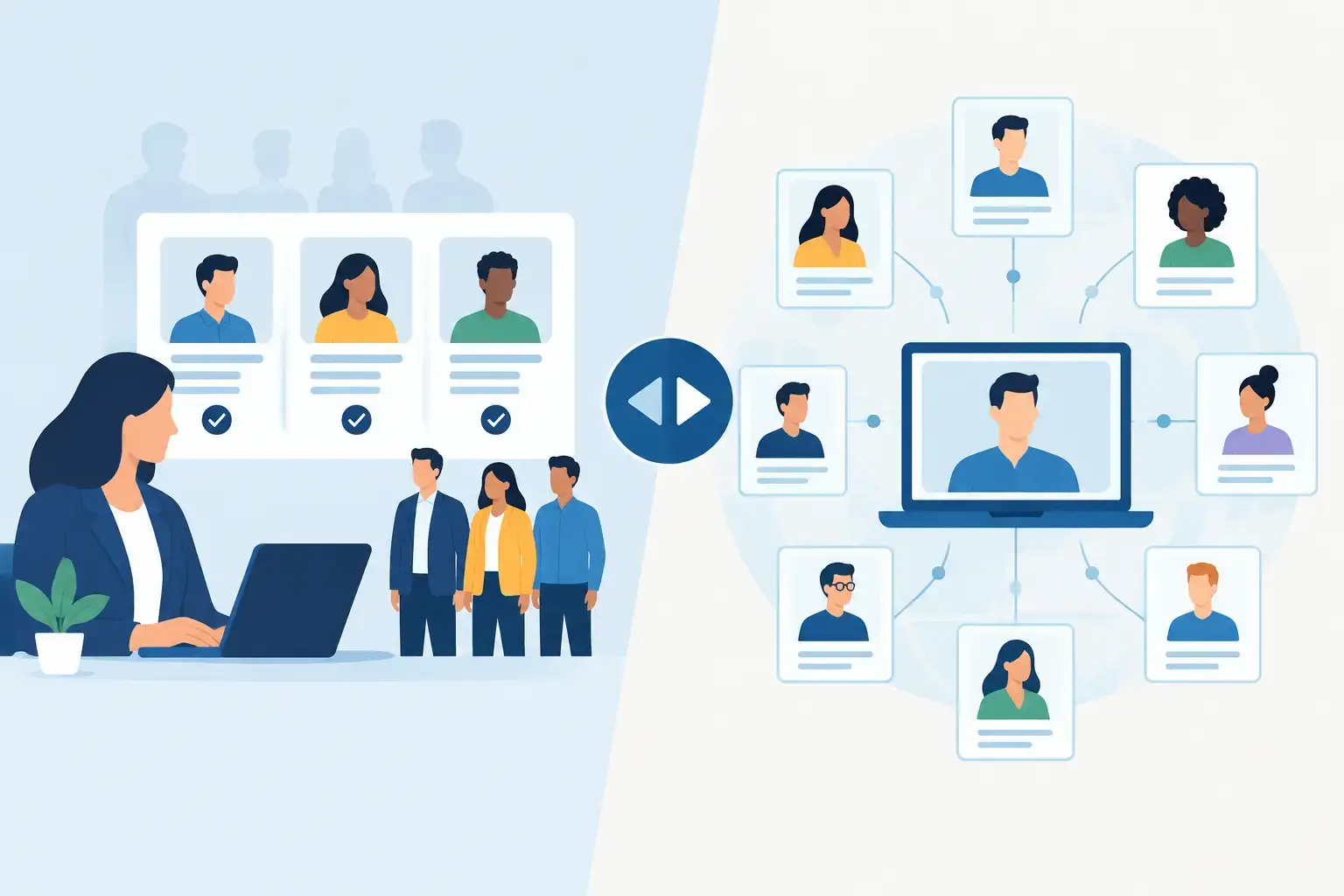
A crew shortfall rarely starts with a lack of names. It starts when the project needs specific craft workers, with current credentials, within travel range, available for the exact outage window. The staffing agency versus talent marketplace decision affects how quickly an employer can find those workers, how much control the hiring team retains, and what workers can see about the jobs they are qualified to perform.
For industrial shutdowns, turnarounds, and maintenance outages, the right model depends on the project plan, internal recruiting capacity, payroll requirements, and how well the employer already knows its labor market. Neither option is automatically better. The practical question is which workflow gets qualified people confirmed and ready to mobilize with the least avoidable delay.
Staffing Agency Versus Talent Marketplace: The Core Difference
A staffing agency acts as an intermediary in the hiring process. The agency sources candidates, screens them to a defined degree, presents workers to the client, and may employ those workers directly for payroll, benefits, insurance, timekeeping, or other administrative functions. The employer pays for that service through a markup, fee, or agreed billing structure.
A talent marketplace is a digital system that gives employers and workers direct access to one another. Employers post jobs, search profiles, review applicants, and communicate with potential hires. Workers build profiles around their trade experience, certifications, location, and availability, then apply directly to relevant projects. The platform organizes the search and engagement process, but the employer retains more visibility into the talent pool and more responsibility for its hiring workflow.
That distinction matters when an outage date is fixed. An agency may be the right answer when a contractor needs outsourced staffing administration or lacks the internal capacity to recruit. A marketplace may be stronger when the team needs to search quickly, compare qualified workers directly, build a preferred-worker list, and keep a usable pipeline for the next outage.
What Changes on an Industrial Project
Industrial labor is not a general hiring category. A project manager cannot fill a critical path position by searching for a broad job title and hoping the details work out later. The worker may need a particular craft background, site-specific credentials, safety training, refinery or plant experience, and confirmed availability for a narrow shutdown schedule.
With an agency, the employer communicates requirements to a recruiter and waits for candidate submissions. This can reduce the employer's sourcing workload, especially if the agency already has established relationships with the required trade. The quality of the result depends heavily on how accurately the requirements are communicated, how current the agency's candidate data is, and how quickly the recruiter can verify interest and availability.
With a marketplace, employers can work from those requirements themselves. They can search talent by trade, location, credentials, and availability; review profiles; assess applicants; and message workers directly. This is particularly useful when project conditions change and the hiring team needs to broaden the geographic search, replace a cancellation, or identify additional qualified hands without restarting the entire request process.
For workers, the difference is just as practical. An agency may present an assignment after matching the worker to a client need. A marketplace lets workers see relevant openings, save jobs, apply on their own schedule, and keep their availability visible to employers who are planning upcoming work. More visibility does not guarantee selection, but it gives experienced tradespeople a more direct route to the projects that fit their credentials and travel plans.
Speed Depends on Where the Bottleneck Is
It is easy to assume a staffing agency is always faster because it supplies candidates. That can be true when the agency has a current, verified roster of available workers in the exact trade and market. A strong recruiter who understands the site, pay structure, onboarding process, and craft requirements can move quickly.
But agency speed can slow down when information passes through multiple people. A workforce coordinator gives requirements to an agency contact. The recruiter searches records, contacts workers, confirms interest, gathers documents, and sends submissions. The employer reviews the slate, requests follow-up, and waits for responses. Each step may be reasonable, but a short outage schedule leaves little room for repeated clarification.
A marketplace reduces some of those handoffs. The employer can see profiles and applications, refine searches, and contact workers without waiting for a third party to relay every update. That does not eliminate vetting. Certifications still need verification, availability still needs confirmation, and site onboarding still needs to be completed. It does make the discovery and initial engagement stages more immediate.
The operational advantage is not simply a faster search. It is faster adjustment. If a worker becomes unavailable, the team can return to the talent search, review matched workers, and contact alternates while maintaining visibility into the hiring pipeline.
Control, Cost, and Administrative Responsibility
The right model often comes down to how responsibilities are divided.
A staffing agency can absorb meaningful administrative work. Depending on the agreement, it may manage payroll, workers' compensation, employment taxes, time records, drug screening coordination, and other employment-related processes. That can be valuable for an employer scaling up quickly or entering a project without enough internal staffing support. The trade-off is less direct control over candidate sourcing and, often, a higher total labor cost through agency markups.
A talent marketplace gives employers more control over who they find and how they engage them. The team can build searches around real project requirements, maintain preferred-worker lists, track applicant status, and communicate directly. This can improve continuity when the same contractor returns to a facility or routinely staffs similar scopes of work.
That control also requires internal discipline. Someone must own the job posting, respond to applicants, review credentials, confirm rates and dates, and keep worker status accurate. A marketplace is not a replacement for a poorly defined workforce process. It is infrastructure for a team that needs better visibility and a repeatable way to manage qualified talent.
For workers, direct access can make job discovery more transparent. They can present their qualifications accurately, state when they are ready to travel, and apply to work that matches their experience. They should still evaluate each opportunity carefully, including assignment length, work schedule, reporting requirements, pay terms, travel expectations, and any site-specific qualification steps.
When an Agency Is the Better Fit
An agency can be the practical choice when the employer needs a partner to handle employment administration along with recruiting. It may also be useful for a sudden labor surge where the contractor has limited internal recruiting capacity or where a long-standing agency relationship provides access to a proven local workforce.
It is especially effective when the scope is well defined and the agency has demonstrated success filling comparable roles. In that case, the agency is not simply forwarding resumes. It is applying current market knowledge, maintaining worker relationships, and taking responsibility for coordination that the project team would otherwise manage.
The employer should still set clear expectations. Define required credentials, project dates, work location, pay information, onboarding requirements, response time, and what counts as a qualified submission. A vague request produces a vague slate of candidates, regardless of who is doing the sourcing.
When a Talent Marketplace Is the Better Fit
A talent marketplace is well suited to employers that want ongoing access to a specialized workforce rather than a one-time batch of submissions. This matters for contractors and facilities with recurring outages, multiple project locations, or frequent needs for the same skilled trades.
It is also a strong fit when qualification details drive the hire. Rather than asking a recruiter to interpret several requirements, the employer can search and filter for workers whose profiles reflect the needed trade, certifications, location, and stated availability. Hiring teams can review applicants in one place, identify matched workers, and keep a record of people they want to contact again.
ShutdownBoard is designed for this specific operating environment: short-duration, credential-dependent industrial work where timing matters and the required workforce is highly specialized. Employers can post jobs, search talent, manage applicants, and communicate with workers, while tradespeople can maintain a project-ready profile and apply directly to relevant opportunities.
A Hybrid Model May Be the Most Reliable Plan
Many industrial employers do not need to choose one model permanently. A marketplace can serve as the day-to-day talent pipeline, giving workforce teams direct visibility into qualified workers and supporting future project planning. An agency can provide additional capacity when payroll administration, rapid headcount expansion, or a specialized recruiting effort requires outside support.
The key is to avoid treating either channel as a substitute for workforce planning. Start recruiting before the outage becomes urgent. Keep job requirements specific. Track which workers completed prior projects successfully. Confirm availability close to mobilization. Maintain clear communication when dates, scope, or onboarding steps change.
For skilled tradespeople, the same principle applies: keep certifications, work history, travel preferences, and availability current. A strong profile is most useful before the call comes, not after a crew is already being assembled.
The best staffing approach is the one that gives a project team a clear line from labor requirement to qualified, confirmed worker. When outage schedules tighten, visibility and readiness are what keep a staffing plan moving.